The Quasquicentennial: A Monthly Lookback – Partners in Progress
Not every project starts with a plan. Some start with cracked asphalt, rusted equipment, and the decision to fix what’s in front of you. In Partners in Progress, the New York Junior League turns small, physical interventions into systems that scale.
For those who remember the late 1980s and early 1990s New York, parks and playgrounds around the city were often the refuge for people experiencing addiction. The crack epidemic was at its height and the Central Park Conservancy was a mere ten years into its restoration of Central Park. Playgrounds, if they could still be called that, were often strewn with drug paraphernalia or worse.
In 1986, artist and activist Keith Haring painted his famed “Crack is Wack” mural on the wall of an abandoned handball court in East Harlem at 2nd Avenue and East 128th Street. Haring was initially arrested for vandalism only to be invited back three months later when then-Parks Commissioner Henry Stern asked him to re-paint the mural. New Yorkers were beginning to reclaim civic spaces that had been ceded to the drug dealers. In many cases, painting a mural was all that could be done, as equipment sat unused, rusted, or broken.
“The playgrounds didn’t exist at all. They were depressing. There was no landscaping. There were no brightly colored murals. It was horrible,” said Marian Bott, who helped launch what would become the League’s Playground Improvement Project, aka PIP.
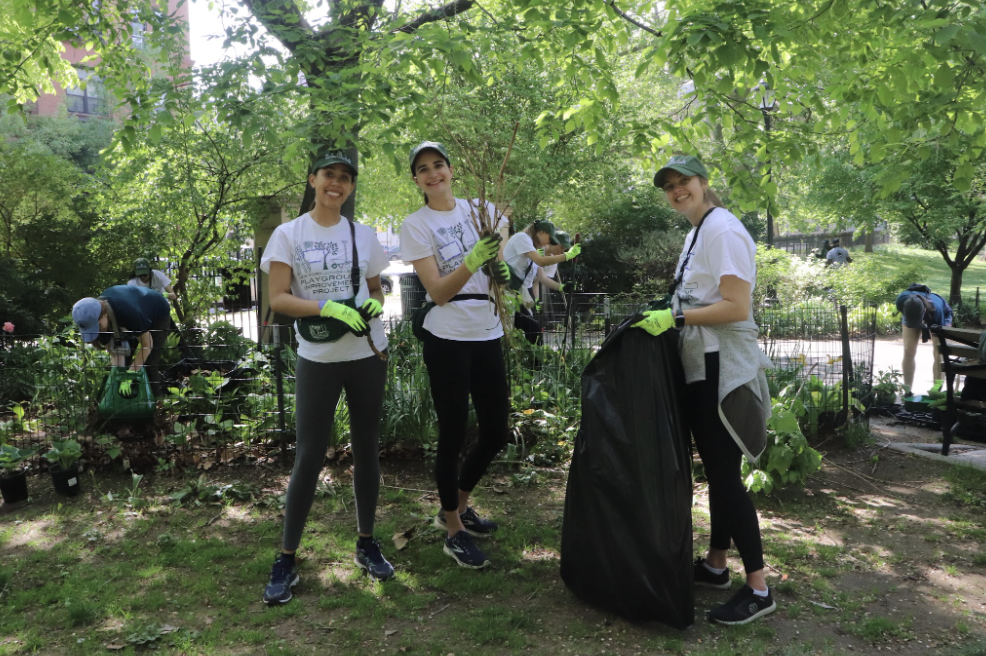
PIP volunteers collect debris in Morning Side Park on May 3, 2025
Marian saw what Haring saw: mile upon mile of cracked asphalt and decay. The desolate playgrounds represented an opportunity to help neighbors while resuscitating the founding mission: volunteer on location. By the late 80s, on-the-ground volunteering had understandably fallen out of favor; it had become dangerous. By that time there were volunteers who had “never seen a public school, let alone a New York City public school.” She pressed the Board and in 1990 volunteers showed up at the Emily Dickinson School playground at 95th and West End Avenue.
“It became a bonding experience for these girls to get into a T-shirt, to pick up a paintbrush, get their hands dirty, and get out of their suits,” she said of the time.
The work that followed included clearing, painting, assembling, rebuilding. It marked a shift back to how the League initially engaged with the city and from planning back to participation. The program quickly became popular for Provisionals fulfilling their volunteer requirement, which it still is to this day. From Hells Kitchen to the East Village to the Lower East Side and Washington Heights, volunteers have shown up at playgrounds and parks, year after year, shovels in hand, ready to work with neighbors to care for neglected spaces.
In a metropolis the size of New York, these are relatively small gestures. But scale has never been the point. From the start, volunteers have always used their on-the-ground experience to inform practical solutions to city-wide problems, such as in 1907 when the League worked with the Board of Education to obtain vacant lots for use as temporary playgrounds. That same year, Past President Dorothy Whitney Straight (1907-1910) supported the work of “School and Home Visitors.”
“These women occupy themselves with the ‘difficult’ school children; those who fall below the standard in attendance, in scholarship or in behavior,” she wrote. “After seeing the children in school and satisfying themselves as to the complaint made by the teachers, the visitors go to the homes and ascertain the cause.”
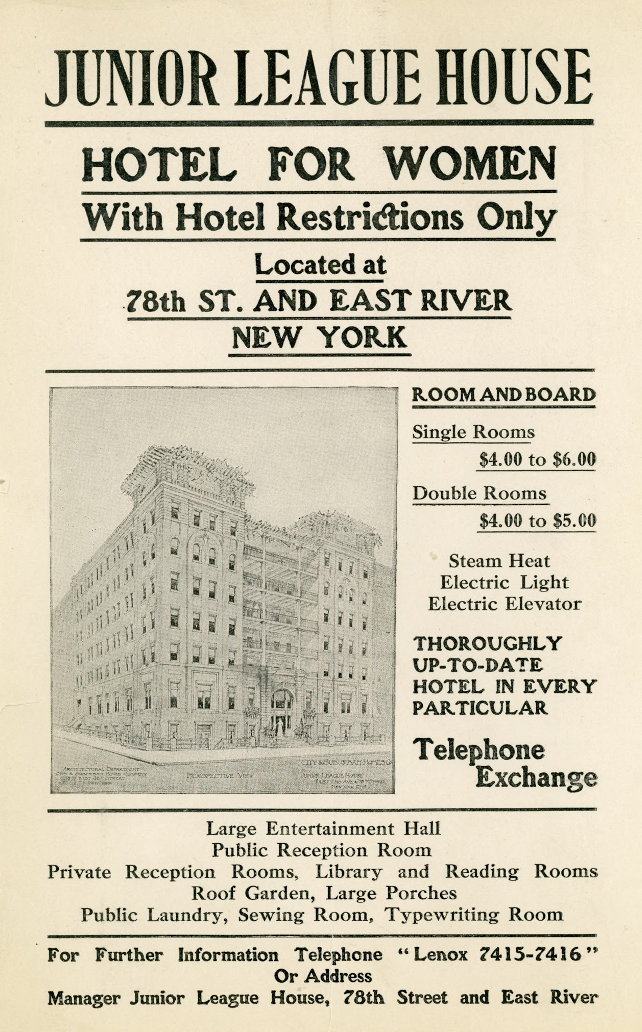
The Junior League Hotel for Working Women, a 274-room hotel for young career women of all religions and nationalities, opens in 1911.
Supporting four “visitors” may sound modest in terms of impact, but the effort also influenced development of the then-nascent field of social work, not only as a profession, but as an academic discipline. As such, the League leadership used their on-the-ground experience in the same manner as they used it to advocate at City Hall, in Albany, and D.C. To borrow a phrase from a past president, “they got under the hood” and then re-approached the problem systemically.
“It is a great pleasure to the League to be able to lend its meagre support to the movements for civic betterment, which are being conducted by the larger organizations of the city,” Dorothy wrote, rather modestly.
One need only look at the names of the early volunteers–Whitney, Corcoran, Olmsted, DeWitt, Chase–to realize that Dorothy and her contemporaries held influence well beyond their “meagre support” for a chosen project. When League women showed up, men in positions of power sat up.
Such was the case when Dorothy met with the City and Suburban Homes Company to build the Junior League Hotel at 78th Street and the East River. The hotel was created to help working women find a safe place to live, as well as a few families. The League raised $287,550 toward the effort, the equivalent of nearly $10 million in 2026 dollars.
The project, though grander in scale, still represented an intervention on the part of the League to solve a problem, which in this case was providing a safe environment for single women. At the time, the building was by far the largest providing housing to women and the only one in Manhattan that did not discriminate against nationality or religion.
From identifying vacant lots for use as playgrounds to providing housing for single women, the League volunteers engaged with the built environment in a strategic manner. By 1909, Mary Harriman took over an abandoned ferry boat, The Susquehanna, to host school children with tuberculosis who were banned from classrooms. Placemaking became a thread that wove its way through the League’s history from the twentieth century to today.
“It’s not just about coming to people where they are, but coming prepared,” said Past President Diann Rohde (1994-1996).
At the end of the 20th century, League volunteers were known for their professionalism and training. By then, the League’s work had expanded into long-term partnerships with scores of nonprofit organizations, city agencies, and community groups.
“The joy of having the Junior League come in is that they manage themselves,” Diann said of partners who engaged with League volunteers. “They made sure there were people there; they planned everything. It was a very different experience than running your own volunteer program.”
Through generations of training, the League was able to scale its efforts across multiple sites. In 1985, they established a signature project with the goal of providing transitional housing for families experiencing homelessness. They partnered with the Children’s Aid Society to fund the purchase, renovation, and operation of three buildings on West 118th Street in Harlem. Here, their role extended beyond funding the space, they also provided the services within it. Volunteers furnished apartments, ran a thrift shop, and organized training sessions for residents in job readiness, resume writing, and interview skills. Volunteers adapted on the fly—learning, for example, that evening programs required more than a syllabus.
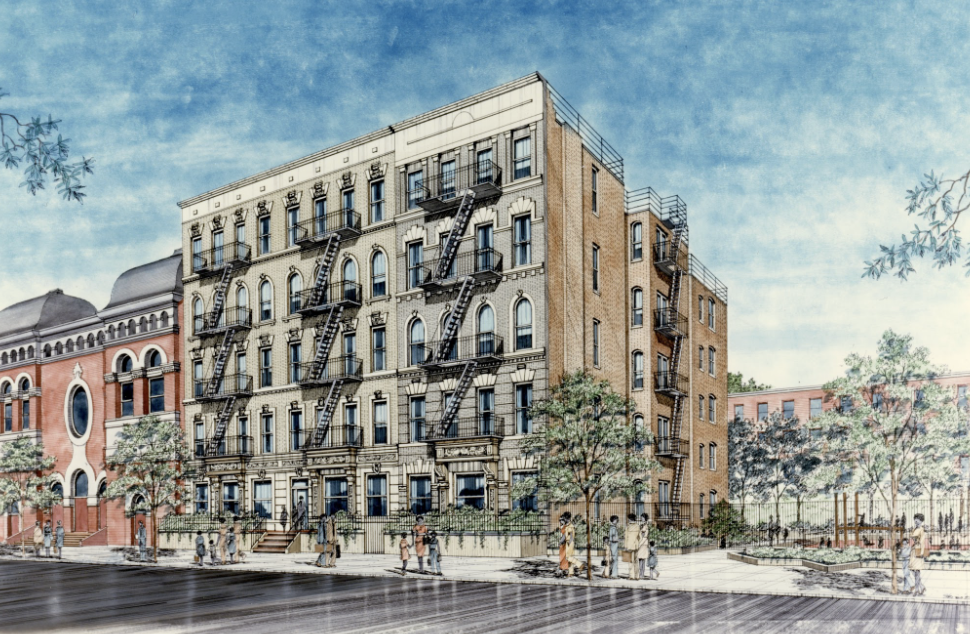
An Artist’s Rendering of the proposed Milbank Pelham Fritz Apartments. Along with the Children’s Aid Society, the NYJL purchases and renovates three abandoned buildings on 118th Street for deserving families.
“Don’t expect to come up at 6:30 at night when people are trying to feed their kids, they’re a single parent, you have no food, and no idea what to do with these kids,” Diann recalled.
From that point forward, volunteers arrived with meals and the children were shuttled across the street where Children’s Aid Society had another location with programming for kids. A model of infrastructure with programming evolved, but that too would change out of necessity.
For several years, the League had been trying to figure out how to invest seed money for community work donated by Helen Watson. It was decided that the money should be used toward women’s health–though few had expertise in the field, so they did what the League often does: they gathered for lunch.
“I organized two lunches and two cocktail parties where I invited all these leaders in women’s health, in children’s health–doctors, big medical organizations–and we put ’em in a room and we asked, ‘What can we do? What’s needed the most?’ And universally, they said, ‘education,’” said Diann.
Volunteers decided to fund the construction of a building with one floor devoted to education. They partnered with Settlement Health, a nonprofit founded as part of a federal initiative to improve healthcare access in underserved communities. Thus the Community Health and Medical Program was born (CHAMP). CHAMP offered classes in nutrition, asthma management, and family health. No sooner was the program up and running when federal regulators ruled that the facility could only operate under a single institutional entity, preventing the League from maintaining an independent program on the very site they helped create. Rather than abandon the effort, the League adapted by taking CHAMP on the road.
“In many ways, it was the best project ever,” said Diann. “We put a million dollars in, they got their education floor built, they gave the money back to us, and we spent it again.”
CHAMP became a more nimble community-based program—one that could operate where needed. Other programs inspired by the model developed, such as Cooking and Health Education for Families (CHEF). Eventually CHAMP folded into CHEF as the needs of partner organizations changed.
“CHEF was the hands-on cooking lessons and CHAMP was really preventive health and wellness, so they had a natural synergy.” said Katie Cook, who helped oversee the merger in 2018. If CHAMP had been initially tied to a single site, CHEF was built to travel.
“We essentially created a portable kitchen and could host these workshops anywhere,” said Katie.
Without the constraints of a fixed location, the program moved on, literally.
“Now we adapt to their space and their equipment,” said Kathryn Meyers, the 2026 co-chair of CHEF.
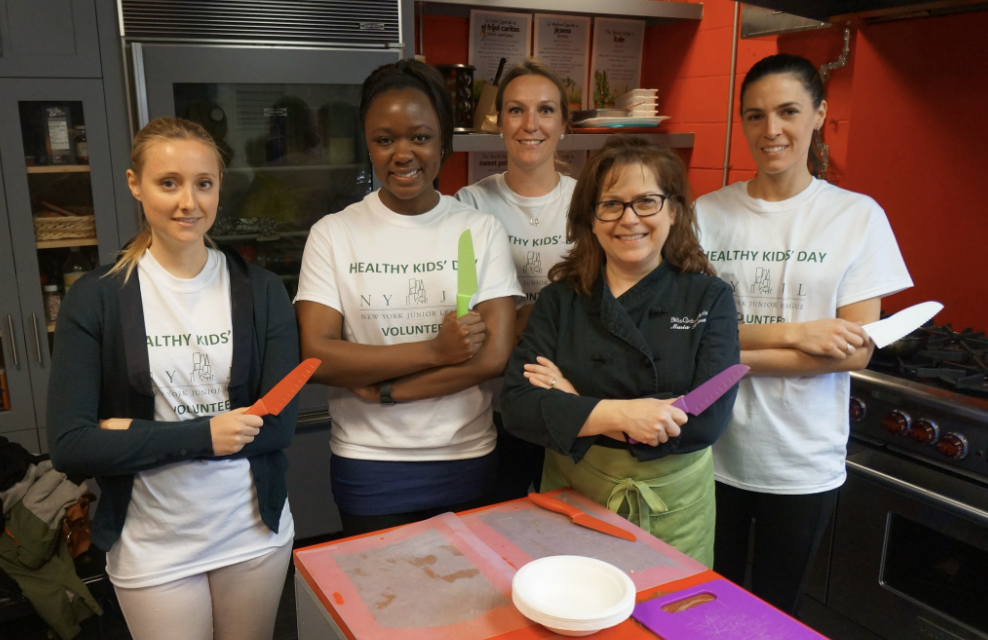
CHEF volunteers at Grosvenor Neighborhood House YMCA for Healthy Kids Day April 30, 2016.
In practice, that has meant working across a wide range of environments and populations, adjusting not only to physical conditions but to the variety of cultures being served as well.
“They evolved, because they learned,” said Diann. “Now they actually go shopping with women and ask, ‘How do you get a healthy meal in a bodega?’ So, it evolved and continues to evolve.”
Kathryn concurred, adding that helping others where they live, helps at home.
“I want my daughter to have a positive relationship with food and to be healthy and strong and all of those things. So those values are very much aligned with this work,” she said. “This really just drives home that providing nutritious, fulfilling food in a warm and inviting environment is the same whether you’re doing that out in the community or when you’re at home.”