
The Quasquicentennial: A Monthly Lookback – Boots on the Ground: Community Impact
From Rivington Street to Bellevue and Building Blocks, NYJL meets members — and the city — where they are.
Imagine, if you will, a hot summer night on Manhattan’s Lower East Side nearing the turn of the last century. On Rivington Street, a young mother sits on a curb with her feet in the gutter, her baby at her breast. The area’s famed fire escapes are packed with sleeping families trying to escape the stifling indoor heat. Children sleep on the steps, on the sidewalks, and in empty pushcarts. It’s 2 a.m.
Lillian Wald, who would later go on to found the Henry Street Settlement, recorded the observation. She wasn’t alone in documenting the Rivington Street squalor. Jacob Riis turned his camera on the street’s rag dumps, where recent immigrants sorted through the muck to make pennies from the resale of the scraps for paper.
Around the same period, a world away on 34th Street, a 17-year-old Eleanor Roosevelt made her debut at the Waldorf-Astoria. Her reality and that of her friends could not have been more distant from the Lower East Side. But fresh from a progressive education in England, she sought out like-minded women who wanted to use their position in society for the good of those with less. It’s no surprise, then, that Roosevelt and Junior League founder Mary Harriman would become friends.
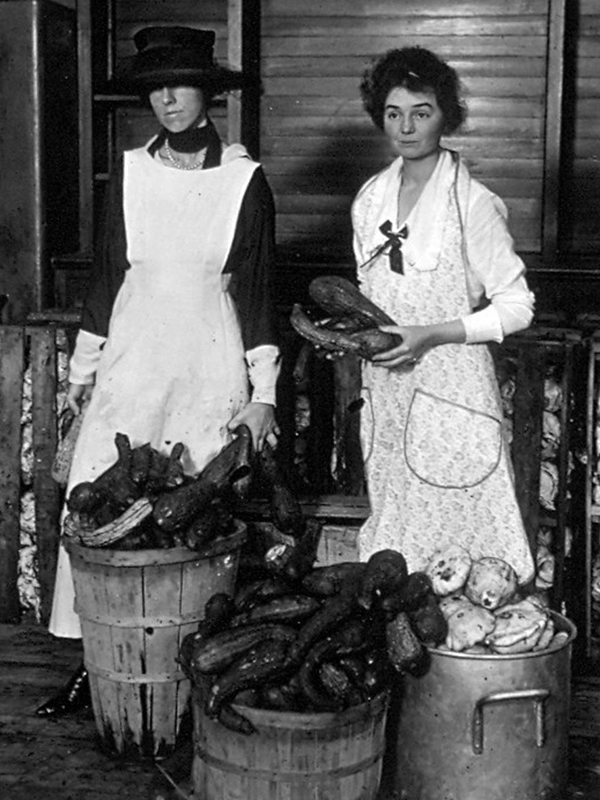
1911: Volunteers taught children art, calisthenics, dance and singing at the Rivington Street Settlement House on the Lower East Side, later expanding to Greenwich House and Hartley House. Committees also supported hospitals, district nursing, visiting teachers, music, entertainment and public lectures.
“They were not afraid to roll up their sleeves and say, ‘I don’t want to sit here and have tea sandwiches; I want to do something to help other people,’” Mallory Morgan said of the “teenage radicals.”
Shortly after meeting Harriman, Roosevelt began traipsing past the Rivington Street rag heaps to teach young people calisthenics and dance at the College Settlement. Did her efforts change lives in the tenements? Perhaps a few. But her volunteerism was an early example of how the League’s boots-on-the ground approach informed other aspects of the work, such as policy and civic action. Indeed, after Eleanor took her then-fiancé Franklin Delano Roosevelt to experience what for her was “the nicest part of the day,” he was left horrified, but would return again several times. If ever there was an example of how the League’s boots-on-the-ground efforts affected policy, it could easily be argued that the future-president’s experience stayed with him as he laid the groundwork for the New Deal.
“He realized then that not everybody went to Deerfield,” Joie Anderson said with a chuckle.
Eleanor herself would later admit that teaching calisthenics could hardly be considered terribly important work, as she was not trained as a social worker.
“But it kept children off the streets and it taught me an understanding of a side of life that might have remained to me a closed book if I had not come in close contact with settlement work,” she would write years later.
Those early years set the tone for generations to come. And if Roosevelt recognized that she lacked the training to make a bigger difference in the lives of the children, then the League had come to the same conclusion. By 1920, a rigorous training program in partnership with Barnard College required new members to attend from October through May, prompting one League historian to write that any member who complains about current training should be reminded that it used to be three days a week for nine months.
By this point in the League’s history, the organization had a robust membership and dozens of community partners, among them Bellevue Hospital. As Bellevue is a hospital of firsts, it’s no surprise that the League would produce its own notable first there: the first system of volunteers in a New York City outpatient department with the hospital’s children’s clinic. By the 1950s, the League was collaborating with Dr. Harold Rusk, a pioneer of rehab medicine, to provide professionalized volunteer support and funds for what eventually became known as the New York University Bellevue Rehabilitation Program, among the first of its kind in the nation. Like so much of the League’s work, once the task of getting the systems up and running was complete, they then handed management back to the community it served, in this case to the Bellevue Social Service Auxiliary. The work at Bellevue continued through the remainder of the century. Joan Benham remembered her first visit to Bellevue as a volunteer with Bellevue Child Life in the psychiatric division.
“Every week when we arrived, the children would light up, ‘The ladies are here! The ladies are here!’ That’s what they would shout,” she recalled.
Once settled in, the volunteers would set about making puppets, a craft tradition that goes back generations for the League. And while Joan remembers the experience fondly, the gravity of the children’s circumstances were never far from her mind.
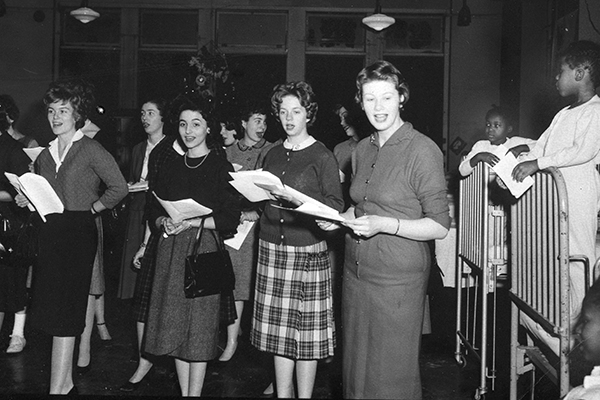
1961: Members of the Community Singers, including Mrs. S. Jerome Dickinson, perform at a hospital facility — an activity the League frequently brought to Bellevue Hospital during this period.
“You see a four-year-old in the psychiatric ward and you think: why is this child here? That was visceral for me. It wasn’t an abstract service. It wasn’t a fundraiser,” she said. “It was standing in front of a child who had already experienced more than he should have.”
Not all volunteer experiences are as intense, Joan said, adding that the Playground Improvement Project stands apart in the most joyous way. Each year, the League selects a different New York City park and spends at least five weekends in the spring and one weekend in the fall painting, gardening, and completing general improvements in the park. To date, 34 playgrounds have been restored. Working beside neighbors, members scrape, paint, rebuild, and clean. For Joan, the playground work represents a shift from volunteering for the community to volunteering with the community.
It’s this commonality that likely represents the biggest cultural shift since Eleanor Roosevelt’s time on Rivington Street. To be sure, disparity endures, but it’s not nearly as stark as the Waldorf-Astoria versus College Settlement. Technology, no doubt, has played a role in making New Yorkers of every stripe relate to one another in ways that would’ve been unimaginable in 1901. In addition, the League has now produced generations of volunteers. Moms have shared their volunteer experience with their children for more than a century.
It’s a testament to the organization’s nimbleness that moms can volunteer with their children, even from home, as Olivia Leon’s mother did when she was young. She remembers watching her mom make holiday crafts that would be sold to raise money for community projects. She even remembers going to meetings with her, partly because they didn’t have childcare and partly because her mom believed that sharing the mission was good parenting.
Now that Olivia has a child of her own, she understands the challenges of maintaining membership while raising a child.
“I didn’t want to be at committee meetings every week and miss family time, and I worried I might have to step away from the League.”
She joined Building Blocks, a space for League members to volunteer alongside single parent families through interactive play. Building Blocks partners with the Single Parent Resource Center. Like the playgrounds, the volunteers were there more as neighbors than as benefactors.
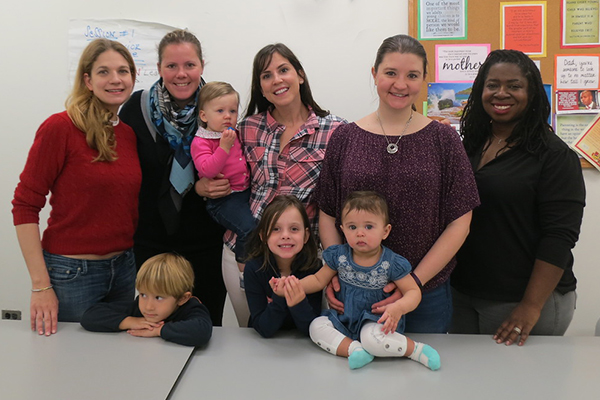
Building Blocks, 2017: In partnership with the Single Parent Resource Center, NYJL’s Building Blocks program brings parents and young children together through interactive play, movement and creative activities. Designed for children ages 6 months to 4 years, the program includes volunteers’ own children, allowing families to learn, serve and grow together. Volunteers with children pictured include Olivia Leon, Allison O’Keefe, Carrie Organisciak, Beth Batiuchok-Colon and Ukeme Emem.
“It wasn’t volunteers and clients, it was parents and kids,” she said.
They were all trying to raise children in New York City. They talked about schools, screen time, and navigating daily life in the city they all call home.
“There was no divide. We were just parents.”