The Quasquicentennial: A Monthly Lookback – “Tempest in a Teapot”
Called a “split,” a “revolt,” and even a “war” by the New York press, a 1919 dispute inside the New York Junior League forced volunteers to confront questions of politics, education, and service. The result was a training system of respectful dialogue that continues to shape the organization more than a century later.
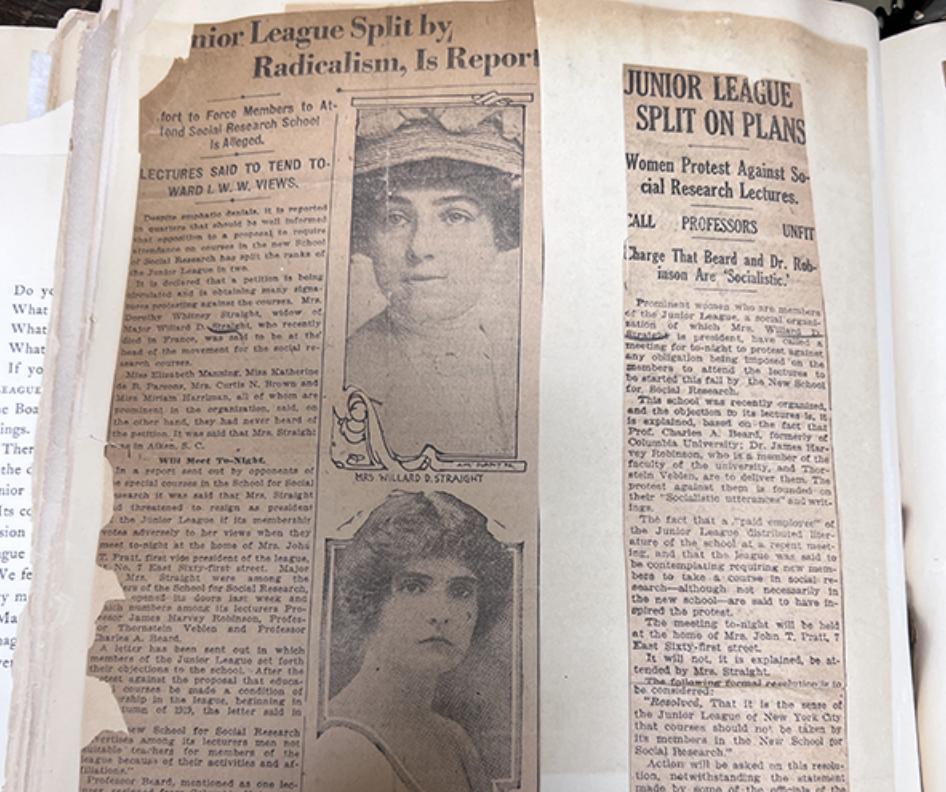
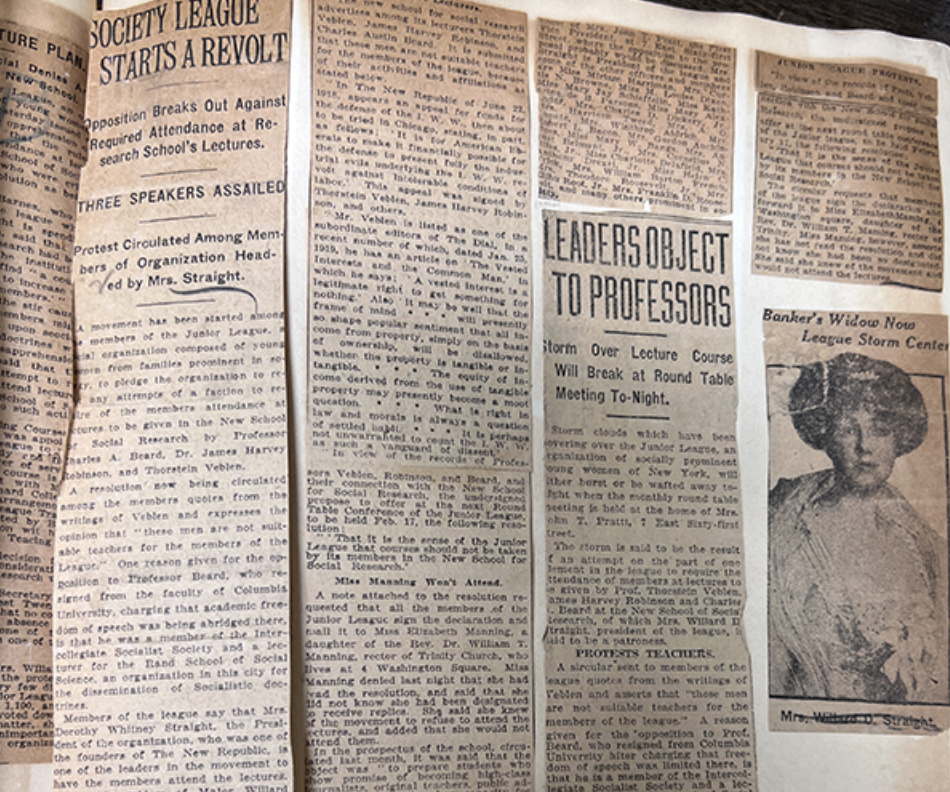
The NYJL archives hold more than a dozen newspaper clippings from 1919 documenting a controversy over how and where volunteers should receive training.
Just a stone’s throw from Central Park and Millionaire’s Row sat the residence of John T. Pratt. Designed by the famed mansion architect C.P.H. Gilbert, the edifice merged two row homes at 7-9 E. 61st St. Architecture magazine celebrated the building’s Georgian interiors filled with American antiques. Pratt was the son of Standard Oil co-founder Charles Pratt. His wife, Ruth Baker Pratt, would go on to become the first New York woman elected to Congress as a Republican. The couple’s home could hardly be perceived as a hotbed of socialism. But in 1919, the New York press framed it as such when the New York Junior League met to formalize its training program.
Today, the NYJL prides itself on being a nonpartisan institution, maintaining standards of respectful discourse. But as volunteers debated the training program, nonpartisan standards were not firmly in place. A rift formed, and New York papers pounced on the story. A scrapbook in NYJL archives includes about a dozen clippings that capture the story. At the time, newspapers released morning, noon, and evening editions, and one paper published the exact address of the Pratt House, where the women met to discuss the matter on February 19.
Several members had accused then President Dorothy Whitney Straight (1918–1920) of socialist tendencies after she proposed that volunteers take courses at the recently opened New School for Social Research, known today as the New School. According to reports, the volunteers were primarily concerned with the “socialistic utterances” of three professors. With the meeting and its location publicized, a reporter from the socialist newspaper New York Call showed up and was promptly denied entry. His resulting article took a dismissive tone, calling the women “those dainty, delightful creatures” and “perfumed and décolletée ladies” intent on avoiding the “mental fatigue involved in taking any course.” Under headlines like “Tempest in a Teapot,” reports elsewhere described the disagreement as a “split,” a “revolt,” and “a war.”
The minutes from that night, which can be found in NYJL’s archives, portray a disagreement but hardly one as fiery as the version portrayed in the press. Instead, the minutes reveal an exacting discourse among civically engaged women in a nation finding its footing after the war. Elizabeth Manning said that she and “a great many members of the League and their parents” found the school to be “radically socialistic and that the League had no right to subject its members to so radical an influence.”
Past President Caroline Slade (1914–1917), who at the time of the meeting was vice chair of the Woman Suffrage Party of New York, disagreed. The meeting notes record her as saying “the world situation is exceedingly delicate and that social revolution exists. Does it seem wise to ignore socialism … and Bolshevist movements and allow them to sow their seeds of harm and danger without any effort of prevention?”
In the end, as no arrangements had been made with the New School, the committee decided to drop the matter and pursue ongoing negotiations with Barnard College. The New School was never the only option; besides Barnard, the YWCA, the Home Efficiency School, and the School of Philanthropy were also contenders. But the debate over engaging the other schools apparently did not sell as many newspapers as that progressive new school opening in the Village.
With the selection of Barnard, one paper reported that “the brief uprising among the young women members of the Junior League is reported to have been adjusted.” The subhead, however, continued to deride the women’s intellect: “Organization Has Decided New Research School Too Advanced, It Is Said.” Never mind that the New School was barely a year old and that Barnard women were held to the same standards as the men at its affiliate, Columbia University. Regardless, the controversy proved an early lesson on how not to allow political discourse to distract from the work at hand. Today, a century later, respectful dialogue is officially one of four core values of NYJL: “We respect individuals. We respect each other, those with whom we work and those we serve in the community. We strive to understand others, to respect differences and to treat everyone with dignity.”
Training soon became a way for the NYJL to distinguish its volunteers from being merely members of a women’s club. These were hardly “perfumed and décolletée ladies,” no matter what appeared in the press. Initial coursework included theory and practice aligned with the developing field of social work. Students would study economics, as well as put in hours at settlement houses. By 1920, the rigorous program required new members to attend from October through May, prompting one NYJL historian to write in the 60th anniversary edition of The Observer that any member who complains about current training should be reminded that it used to be three days a week for nine months.
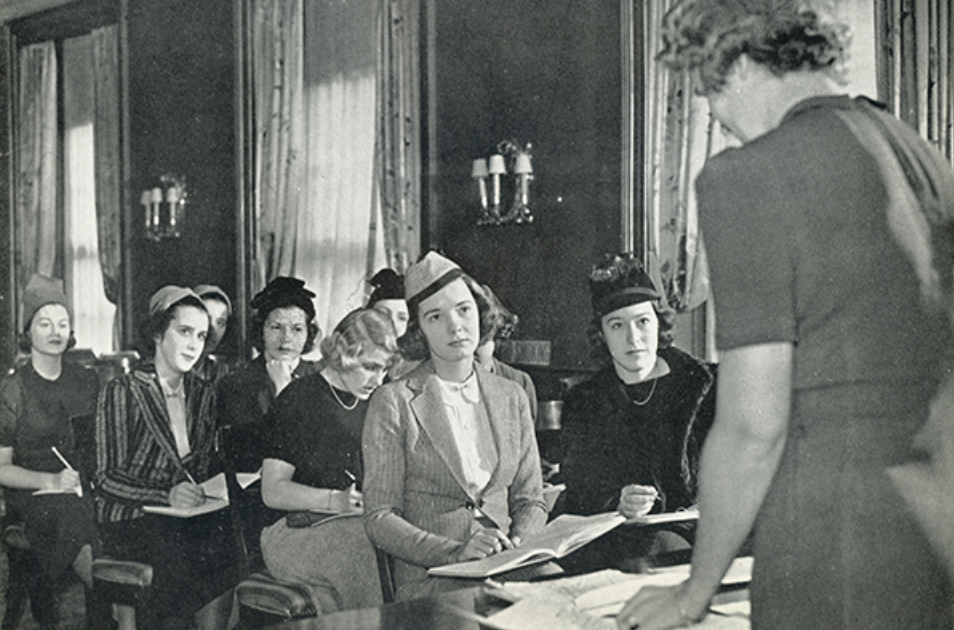
Provisionals attend their first training course in the December 1937 cover photograph of The Observer. Renamed from Tell and Tell in 1936, The Observer documented the League’s volunteer service, project research and community improvement efforts.
The training program would evolve over the years not only to distinguish the NYJL from other women’s organizations but also to define the governing structure from learning to leadership. New members entered a training phase as Provisionals, during which they came to understand the organization’s mission, expectations, and the fundamentals of volunteer service. After a year of training, they became Active members and could then take on committee placements and project work with community partners. After fulfilling Active service requirements, members transitioned to Sustainers, a long-term role focused on mentorship, governance, and institutional continuity—and the occasional Mah Jongg game.
Learning wasn’t always formalized. Adapting what students learned in the classroom to what volunteers saw on site was also part of the process. As the training program evolved, it adapted to the times, to the communities being served, and to the lives of the volunteers. In the early days, with NYJL’s focus on the settlement movement, the training paralleled the field of social work. Later, as women joined the workforce, the training morphed once again.
“We came to recognize that you have to train volunteers not only in what they’re doing but also around leadership and leadership skills,” said Barbara Paxton.
Barbara said that as women were promoted to positions of authority, the NYJL always developed internal resources around their talents. Women were also taking leadership positions at other nonprofits, which led to training programs focused on nonprofit boards.
“I work with nonprofit boards, and I’ve run into organizations where they can’t find anybody who wants to be on the board or in leadership,” said Barbara. “The Junior League has the opposite of that problem.”
Volunteers can stay on a particular committee and in leadership positions for only a limited amount of time. This keeps the organization in flux, with volunteers continually training for their next role. As Active members become Sustainers, there is a constant need to train the next generation of leaders.
“There’s a stair-stepping of training that helps every member be continually prepared for when she is ready to step into that next role,” said Diann Rohde. “If they do take on a role as a co-chair or a board member, there’s training that’s specific. And our community partners provide training that’s more content-specific.”
Training is no longer confined to the Provisional period. Instead, it unfolds throughout an Active member’s experience, with even Sustainers returning for lectures and programs that qualify as training. At the same time, the demands on members’ time have changed. The monthslong programs of the early years—once a defining feature—are now a nonstarter for members balancing careers and family life. Even committing to a weekly course over several weeks can prove difficult, prompting the NYJL to rethink not only what it teaches but also how it delivers that instruction. The answer came, as it so often has, under duress.
The word “pivot” was used so frequently during and after the COVID-19 pandemic that it made the drastic shift from in-person to online seem inevitable. Before the pandemic, most meetings happened in person. The NYJL had pivoted many times before, during the war years and in the aftermath of September 11, the pandemic was no different. It did not necessarily change the work as much as how it was delivered. Training, which had required in-person attendance, had to be reimagined overnight.
What followed built upon a shift that was already in progress, said Executive Vice President Nikki Hudak. Training centered on the needs of community partners and didn’t necessarily have currency beyond the task at hand, something that members could use in their work life or on other boards. Nikki took over the Training Council in 2020 during what she described as “a crossroads moment.” The pandemic accelerated a programmatic reassessment already underway.
“For a period of time, training lacked consistency,” said Nikki. “We had to be more intentional about content about how it was structured.”
The Council now organizes training into three distinct tracks: Nonprofit Education and Training (NET), Volunteer Education and Training (VET), and Leadership Development Committee (LDC). Together, the programs train members in nonprofit governance, volunteer skills, leadership development, and community engagement. The structure reflects a decidedly professional approach that develops volunteers well beyond volunteerism.
“We want volunteers to take training seriously,” Nikki said. “We want it to be the same presentation that you’d get at a college.”
In the past, the training program operated on a limited budget, with members often relying on connections and favors to get a professional behind the lectern. By the end of the pandemic, an increased budget allowed for higher speaker fees and the online format widened the talent pool, all of which increased participation among volunteers. What was born of necessity has become today’s hybrid model.
For Leslie Zemnick and Raquel Ringgold, who co-chaired the in-person training session on nonprofit fundraising that set the first scene of this book, the opportunities presented by hybrid meetings and artificial intelligence have created unparalleled opportunities to learn, especially when combined with good old-fashioned in-person events.
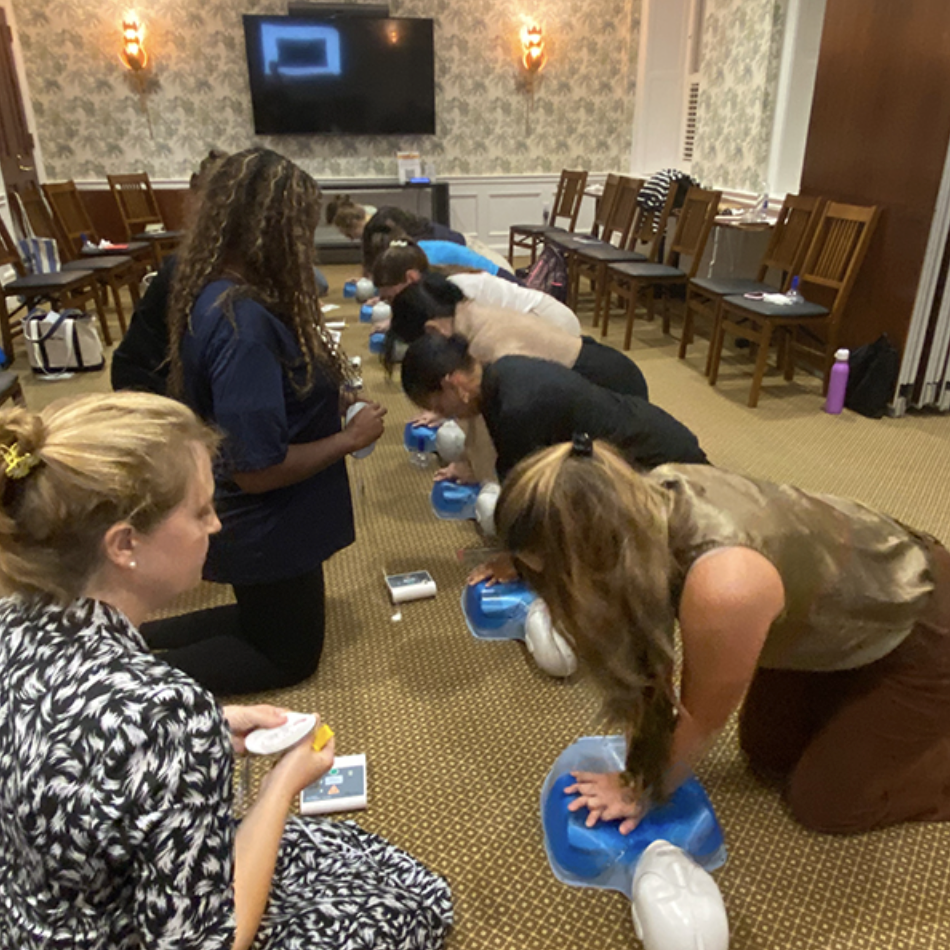
CPR training during the NYJL’s fall 2025 “Find the Good Day” initiative. This annual AJLI program highlights community service efforts, including projects supporting families and local communities.
“Nowadays you have every resource at your fingertips. There’s great literature you could tap into, and now with AI there are a lot of ways people assume they can self-learn,” said Raquel. “But through our in-person training, you still see how important it is to physically practice and hear from these nonprofit experts.”
Raquel said that the truth of the matter is that many NYJL volunteers go on to serve on a number of boards, where they will need to speak publicly—not just online.
“After you did all the studying and all the learning, then you have to actually do the thing,” she said. “That simply comes through training, of being able to speak to other leaders and getting comfortable in those formats. As a League member, you’re comfortable in that space. You’re not in a foreign land.”
She added that it’s important to remember that the technology is not available to all. For most of the populations that the NYJL serves, hybrid is not the norm.
“You have to be able to know how to do things the old-school way, alongside the high-tech model that we all know and love,” she said.
And as much as things change, the more they remain the same. A century after debates on theory and practice played out in the living room of Ruth Baker Pratt, volunteers still debate the tension between the two.
“I personally don’t like professional development programs and adult learning programs that just teach you the theory and then you have to apply that learning on your own time,” said Leslie. “You have a wonderful time and then all of the learnings go into a notebook that just ends up on a shelf and dies. You don’t get to practice it.”
Nathalie Henderson recalled the same tension in her 1956 essay for The Observer. She cited a course on “Social Problems” taught at Barnard College by “a fine man.” It was not very successful, she wrote, because it was too theoretical. “From this finally evolved the basic pattern, far more sound, of studying the various city departments to give Provisional members a first-hand contact with their community set-up, some picture of the immediate social problems involved.”
And, as in 1919, the debate remains respectful—regardless of what outsiders say. Indeed, today the NYJL trains volunteers in best practices for respectful dialogue, including unconscious bias, said Nikki.
“We always ask, ‘How do you have a difficult conversation? How do you get started? How do you have respectful communication?’”
These are questions that Nathalie Henderson might have asked more than a century ago. In her 1951 anniversary essay for The Observer, she wrote about the evolution of training after the much-publicized debate over which school to attend. The debate came down to theory versus practice. The important thing, she wrote, was for volunteers to have “firsthand contact with their community.” Ultimately, respectful dialogue yielded a culture that survives to this day.
“How to remain sensitive as well as intelligent is the vital matter,” she wrote.