
The Quasquicentennial: A Monthly Lookback – Advocacy: Radical Staying Power
New York Junior League volunteers have been pushing for social reform since 1901—and they’re still at it.
There is a photo in the New York Junior League archives that almost feels confrontational. Taken in 1977, it shows Past President Mary Ellen Fahs (1970-1972) standing with four Black men, including Jesse Jackson and Thom Turner of the Urban League. Mary Ellen looks straight into the soul of the camera, hand on hip, right brow arched.
The image calls to mind “Radical Chic: That Party at Lenny’s,” the famed New York magazine article written by Tom Wolfe in 1970. Wolfe’s article skewered the Philharmonic conductor Leonard Bernstein and his wife Felicia for hosting a fundraising party at their Dakota apartment for the Black Panthers. Wolfe contrasts Felicia’s “perfect Mary Astor” voice with men in dark glasses and big afros.
But the photo of Mary Ellen tells a different story.
“A lot of people think that the sixties are the time that everything changed. Well, it’s really in the seventies that things start really shifting,” Past President Cynthia Cathcart (2004-2006) said of the period.
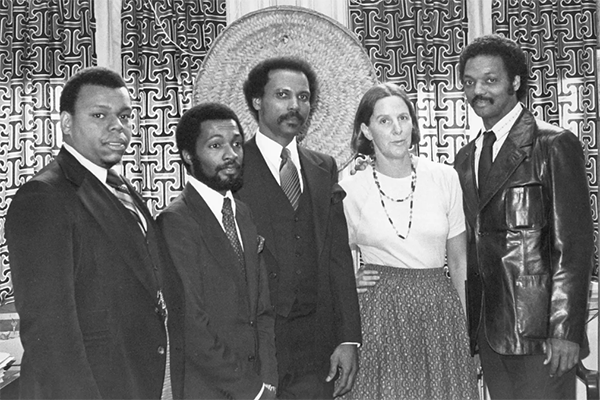
New York Junior League President Mary Ellen Fahs (1970–1972) works with civic and education leaders, including Jesse Jackson and Thom Turner of the Urban League, as part of the Educational Priorities Panel in the mid-1970s. (Public Education Association)
The reality behind the photo is hardly that of a cocktail party on the West Side. Rather, Mary Ellen was serving alongside Turner and Jackson on the Educational Priorities Panel, a coalition of civic organizations formed to focus attention on spending practices and fiscal priorities of the New York City Board of Education.
“The League looked like a traditional organization, when underneath they were making extraordinary changes–sometimes just by showing up and doing what needed to be done,” said Cynthia. “There’s perception, then there’s reality.”
Mary Ellen, who passed away in 2021, described the decade as “a time of a lot of advocacy.” She credited her predecessor Past President Barbara Goodman (1968-1970) with introducing her to members of the Urban League during Goodman’s tenure. Eventually, she was asked to co-chair the Urban League’s New Year’s reception. Advocating for change outside eventually led to change inside.
“The time had come for the Junior League to admit an African American woman,” she said of the period. “We set out to find someone who would want to do this, but a lot of eligible African American women were busy doing their own charities, in their churches, and in organizations like 100 Black Women.”
Eventually, the League did find someone who was interested, and the first Black member was voted in during her tenure. It was an effort that shaped the way she viewed her work and the world.
Years later, Mary Ellen earned a doctorate in psychology from Columbia and continued advocating for equity in education, which eventually led to the 1977 photo with Jackson. She commuted daily to Harlem, taking the subway when taxis refused to go that far uptown, said her nephew Reade Fahs. Reade recalled her telling him of one trip where, as usual, she kept her head down reading a book when a group of young men surrounded her.
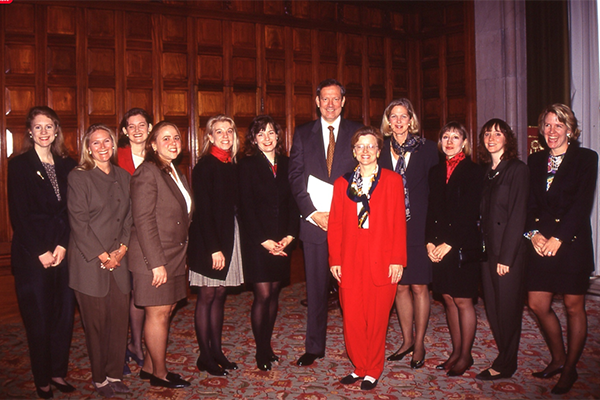
Members of the New York Junior League’s Advocates for Public Policy Committee meet in Albany, N.Y., on March 7, 1995. The League later supported mental health parity legislation including Timothy’s Law, enacted in 2006.
“Mrs. Fahs, what are you doing on this subway? This is not safe for you,” said one.
Like her predecessors at the settlement houses generations before, the neighbors knew her. They were her students. She worked directly with middle school students and later founded a parenting program for mothers whose children had been born with AIDS exposure, drug dependency, or fetal alcohol syndrome.
“She had this remarkable ability to travel across race and class,” Reade said. “She was equally comfortable and at home all up and down the spectrum.”
That fluency—moving between Park Avenue and Harlem classrooms, between luncheons and policy meetings—was not a contradiction. It was part and parcel of a legacy that goes back to when Mary Harriman and founding members decided to donate flowers from their debutante balls to hospital wards. One wonders what Wolfe would have made of that gesture–a gesture that eventually grew to include supporting settlement houses in 1901, a committee to study all laws related to women and children in the city in 1923, and direct lobbying of Congress for birth control in 1931.
Decades after the tenure of Fahs and Goodman, their efforts to advocate beyond their comfort zone came home in a big way.
“I was the first Black president of the Mother League, as I would say,” recalled Past President Gena Lovett (2008-2010).
Gena’s first memory of the League was seeing members in the paper while growing up in Arkansas. Yes, they were appearing in the society section, but that’s not what made her want to join.
“I saw the impact that they were having with Black kids, and that was in the newspaper and they had smiling faces,” she said. “I said, ‘One day I want to be a part of that Junior League, if this is what they do. They make people happy and I want to make people happy too.’”
Gena built a career on Wall Street and joined the League in New York. Over time, she moved through placements and public policy committees, serving as chair and co-chair, traveling to Albany for advocacy days. She recalls the League’s involvement in the “Scald Burn” law—which requires landlords to establish a maximum tap water temperature of 120 degrees after incidents in which children and elderly residents were severely scalded. From there, Gena began working on an initiative addressing domestic violence and abuse, partnering with then–Brooklyn District Attorney Charles Hynes to support reforms.
But the work that inspired her most was with the Women’s Prison Association, where she joined the board and eventually became its president, serving in that role when she later took the helm at the League. At the Association, she was inspired by a women’s advocacy project, where formerly incarcerated women went to hearings at City Hall and advocated in Albany.
“Who better to advocate for their causes than the women who are most affected?” she said.
It would not be long before Gena graced the cover of Forbes magazine, under the headline “In a Different (Junior) League.” Needless to say, the offices of the hedge fund where she worked impressed. So, it was with a particular delight that she invited the women to the office for lunch with a commissioner from the Department of Corrections. She said that for many of the women, it was the first time they had been inside a Manhattan office tower–let alone be treated as dignified guests at a plated lunch.
“If nothing else, they could honestly say that, listen, someone treated me with respect and someone listened to me,” she said.
The moment crystallized the meaning of League advocacy for her.
“I got underneath the hood,” she said.
Not unlike Eleanor Roosevelt teaching dance at the Rivington Street Settlement, Gena appreciates the value of direct contact with the community she is advocating for. They’re not an abstraction or a concept, they’re people.
Dana Vogel’s work reflects the same ethos.
Through the Crisis Intervention Committee, Dana has trained and volunteered with New York-Presbyterian’s DOVE Program, responding to emergency rooms when survivors of sexual assault helping ensure that victims receive proper care in the hours after an attack.
“If I can ease that burden even a little for someone on the worst day of someone’s life, I feel like I’ve made a bigger impact than I could doing anything else all year,” Dana said.
Though not a member of the Advocacy for Public Policy Committee, Dana has participated in city and state advocacy days. When legislators question proposed domestic violence legislation, she offers firsthand accounts.
“They’ll say, well, this seems like a good bill, but they want to ask questions, which I think is very normal and healthy and I’ve had so many cases that I’ve been able to cite back to them,” she said.
That pipeline, from frontline volunteer to policy advocate, is by design.
“I believe that every volunteer is an advocate,” Gena said.
Still, the stereotype persists: the balls, the luncheons.
But Gena said there’s nothing to be ashamed of when meeting for a cause.
“The pearls and the lace and all the things that people talk about about the Junior League, yes, that’s true… but why can’t we do both?” she said.
The balls finance programming. Networking in New York opens doors locally and nationally, which often leads to reform. The record speaks for itself.

Members of the New York Junior League (from left) Folami Green, Kristina Kloberdanz, Sara Laughren, Nanette Heide, Gena Lovett and Christine Drinan share a laugh following the NASDAQ Closing Bell Ceremony on Feb. 20, 2009.
In 2006, the League successfully lobbied for Timothy’s Law in New York State, named after 12-year-old Timothy O’Clair, who died by suicide after his parents were denied insurance coverage for mental health treatment. The law mandates that insurers provide coverage for serious emotional disturbances in children and treat certain mental illnesses as they do physical illnesses.
In 2022, after member Michelle Alyssa Go was pushed in front of an oncoming train by a man diagnosed with schizophrenia, the League redoubled efforts for mental health access by supporting federal legislation designed to expand access to Medicaid-funded inpatient psychiatric beds for individuals seeking treatment. Rather than looking inward, the League–and Michelle’s family–responded nationally.
From advocating for education reform to promoting legislation that responds to mental illness, the League has shown its willingness to evolve with the issues, but the institutional memory is long. They’re not new to the game.
If there’s a lesson to be drawn from the 1977 photo of Mary Ellen Fahs and Jesse Jackson, it’s this: Never assume. That well dressed woman in pearls could be on her way to Park Avenue or to the subway.
That’s radical chic.